CAMAG®
Automatic Developing Chamber 3

Precise and reproducible chromatogram development with full process control

In a nutshell

the new standard for reproducible development

The CAMAG Automatic Development Chamber 3 (ADC 3) continues the proven reliability of its predecessor in High-Performance Thin-Layer Chromatography (HPTLC), offering consistent, fully automated plate development to support reproducibility and data integrity.

Designed for 20 x 10 cm HPTLC plates, the ADC 3 features an integrated Twin Trough Chamber that ensures stable analytical conditions and minimizes variability. It offers full flexibility in solvent selection and development parameters, supporting a wide range of applications.

All critical steps – saturation, activation, pre-conditioning, development, and drying – are fully automated to eliminate environmental influences and deliver reproducible results. The built-in humidity control enables chromatography at defined layer activity, essential for robust method development and for evaluating humidity effects.

Seamless integration with visionCATS software ensures compliance with cGMP/GLP and 21 CFR Part 11, making the ADC 3 a reliable choice for regulated laboratories that demand precision, traceability, and efficiency.

  • Fully automated chromatogram development
  • Integrated Twin Trough Chamber (20 x 10 cm)
  • Built-in humidity control for enhanced reproducibility
  • Software-controlled by visionCATS
  • Compliance with cGMP/GLP and 21 CFR Part 11

DESIGNED FOR THE LABORATORY

The ADC 3 simplifies lab work with efficiency, reliability, and flexibility. Whether you’re handling routine quality control or complex samples, it seamlessly adapts to your workflow. visionCATS HPTLC software allows you to define all parameters to meet your specific needs, offering complete control and full traceability.

Consistent Results Across Labs

The ADC 3 minimizes variability arising from both operators and laboratory environments, ensuring repeatable results every time.

Precision Through Automation

Fully automated plate handling and built-in system checks reduce user errors and improve reliability.

Increased Productivity

Automated plate development allows analysts to multitask during runs, improving overall workflow efficiency.

Regulatory Compliance

visionCATS integration enables secure parameter control, traceability, and data recording, supporting compliance with cGMP/GLP, and 21 CFR Part 11.

BUILT FOR THE USER

The ADC 3 is fully controlled via the visionCATS  HPTLC software, enabling automated development with maximum reproducibility and compliance. Key parameters are precisely managed, including:

  • Timing for chamber saturation, plate activation, pre-conditioning, and drying
  • Solvent introduction during saturation, pre-conditioning, and development
  • Monitoring of migration distance and development time
  • Monitoring of temperature and relative humidity

Thanks to its intuitive interface, visionCATS guides users of all experience levels through setup and  execution. Once all preparatory steps are complete, the  system performs the development fully automatically under standardized conditions, allowing the user to focus on other tasks.

The entire process is continuously monitored and all data is recorded in accordance with cGMP/cGLP requirements. After development is complete, the plate is ready for the next process step of the HPTLC  workflow.

The development settings dialog provides user-friendly default configurations, with all parameters fully customizable to individual requirements.

The development settings dialog provides user-friendly default configurations, with all parameters fully customizable to individual requirements.

HOW THE ADC 3 WORKS

Pre-drying

Removes residual solvents before development

After sample application, the plate is subjected to a controlled pre-drying process. A built-in blower operates for a defined duration, eliminating any remaining solvent from the stationary phase, ensuring optimal conditions for reproducible results.

Chamber Saturation

Establishes a stable solvent environment

Before development, the twin-trough chamber is saturated with solvent vapors to create a consistent internal atmosphere. This ensures uniform distribution of vapors across the plate. A saturation pad further enhances vapor dispersion, contributing to reliable chromatographic behavior.

Pre-conditioning

Equilibrates the stationary phase

During pre-conditioning, the dry stationary phase is exposed to solvent vapors in a controlled environment. Solvent molecules present in the gas phase interact with the surface of the stationary phase, leading to modification of its properties.

Plate Activation

Humidity control for reproducible performance

In most standardized methods, the plate is activated with air at a controlled relative humidity. Within a closed system, humidity is regulated using a saturated salt solution or molecular sieve.

Post-Development Drying

Prepares the plate for detection or evaluation

Once the development reaches the target migration distance, the plate is transferred to a drying unit. A controlled blower removes remaining mobile phase solvents, preparing the plate for the next analytical step.

Rinsing Procedure

Clean transition between solvent systems

When switching solvents, the system can be rinsed by adding solvent to the funnels. The glass tank can either be easily replaced with a clean one or cleaned and dried for reuse.

CONSISTENT RESULTS THROUGH CONTROLLED HUMIDITY

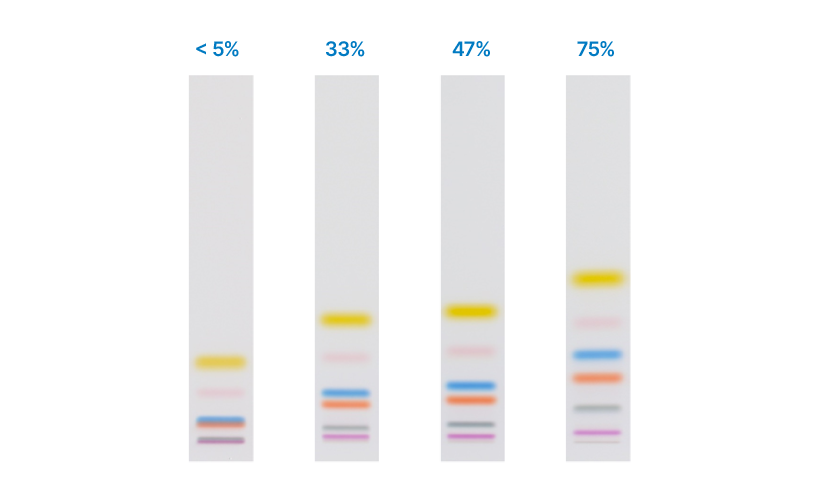
Chromatographic separation on HPTLC plates is affected by humidity, which can vary by season and location. The CAMAG® ADC 3 features a fully integrated humidity control, automatically regulating relative humidity around the plate. This enables both standardized and custom settings, ensuring reproducible results under changing environmental conditions.

Humidity effect on test dye separation

Developing solvent: toluene

Technical specifications

  • Classification of installation and use
    Class I, installation category II, protection class IP20, Pollution degree 1
  • Operating temperature
    15 – 30 °C
  • Recommended working temperature
    20 – 25 °C
  • Humidity
    Maximum relative humidity 80 % for temperatures up to 30 °C (Humidity and temperature conditions must not cause condensation!)
  • Maximal altitude
    2’000 m
  • Plate types
    HPTLC glass plates 20 x 10 cm, layer thickness 200 µm
  • Operating voltage
    100 – 240 VAC; 50 / 60 Hz Fluctuations ±10 % of the nominal voltage
    Overvoltage category II
  • Power consumption
    60 W
  • Fuses
    2.0 AT, 250 VAC
  • Dimensions (W x D x H):
    315 x 320 x 495 mm
  • Weight
    ~ 17kg
what’s included

Ordering Information

Discover our comprehensive range of packages and make your selection today

Interested in the product?

Reach out to your local distributor and enjoy faster, improved results at reduced costs.

Download

Related documents

Download manuals for in-depth device guidance
Brochure ADC 3
November 3, 2025
Firmware ADC 3 (1.4.1.4)
November 26, 2025
Instruction Manual ADC 3
July 18, 2025
Qualification ADC 3 for TLC Scanner
August 12, 2025
Qualification ADC 3 for TLC Visualizer
August 12, 2025
Declaration of Conformity (EC) ADC 3
August 12, 2025
Declaration of Conformity (UKCA) ADC 3
August 12, 2025
SOP 319/01 – Operation Qualification ADC 3 under visionCATS
August 26, 2025
SOP 318/01 – Installation Qualification ADC 3 under visionCATS
August 26, 2025
SOP 317/01 – Environment Specification ADC 3 with visionCATS
August 26, 2025
Service Manual ADC 3
October 8, 2025

Related products

Find the most suitable instrument for your specific requirements